How to read a Spanish news headline: 5 patterns
Headlines are the hardest sentences in a Spanish news story, and they're the first thing you read. They break the rules you were taught: things that already happened are in the present, articles disappear, and half the sentence is sometimes missing.
The good news is that they break the rules in the same few ways every time. I went through the headlines of our 26 stories from October 4–27, 2026. The median was 13 words, the shortest 6 and the longest 22. Seven had a colon, three were questions, and four had a quotation in them. Here are the five patterns that explain almost all of them.
1. The past is told in the present
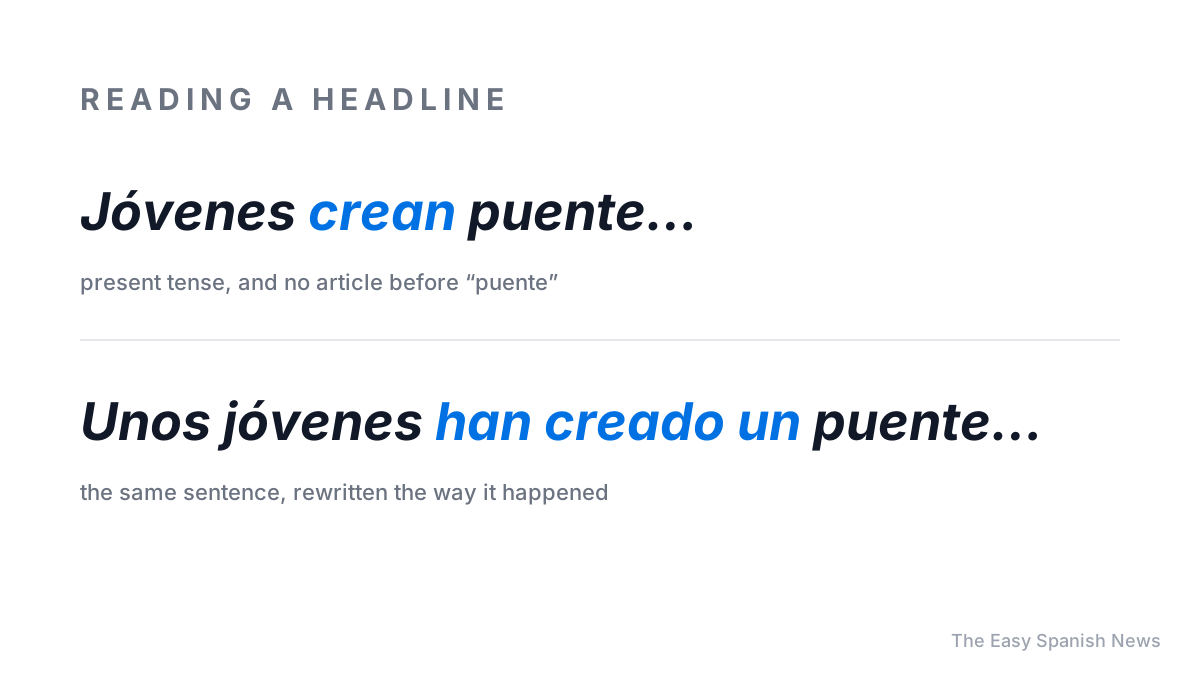
Jóvenes crean puente sobre la brecha climática entre Oceanía y el Caribe.
The bridge already exists. The story is about something that has happened, but the headline says crean (create), not crearon or han creado. Headlines use the present to make news feel current, in Spanish just as in English ("Students build bridge").
So when you read a headline verb in the present, don't assume it's happening right now. Read the first paragraph to find out when.
2. The little words go missing
Los togoleses reinventan protesta política ante represión contra la sociedad civil.
In a normal sentence that would be la protesta política and la represión. Headlines drop articles to save space, which is why they can feel like a list of nouns. Put the articles back in your head and the sentence becomes ordinary Spanish.
3. The first words set the scene
A lot of headlines open with a short phrase that tells you where or when before getting to the news:
- Tras las inundaciones, Nepal necesita cifras claras sobre la ayuda recibida. Tras means "after". It's more formal than después de and much more common in headlines.
- En Camerún, antes de las pantallas estaba la pista de baile. The place comes first, then a comma, then the story.
- Cómo dos elecciones moldearon la frontera entre India y Bangladesh. Four of our 26 headlines started with Cómo (how). It signals an explainer, not breaking news.
4. The colon splits topic from story
La tecnología al servicio del tráfico humano: migrantes de Bangladesh se convierten en víctimas de captación en Camboya.
Before the colon: the big topic. After it: the specific story. If the first half is hard, skip to the second. It's usually a plain sentence with a subject and a verb, and once you understand it, the first half makes sense too.
5. Questions can start in the middle
Tras cinco años de guerra, ¿cómo se mantienen los pequeños comercios en Ucrania?
Spanish marks a question at the start as well as the end, and the opening ¿ goes where the question begins, not where the sentence begins. Everything before it is scene-setting. Here, the question is just "how do small shops keep going?"
A two-step habit
When a headline loses you, try this before you look anything up:
- Find the verb and ask what tense the event is really in. Usually it's the past.
- Rewrite it as a normal sentence in your head, with the articles back: Unos jóvenes han creado un puente…
It takes ten seconds, and it turns the hardest line of the story into one of the easiest. Try it on today's headline, then read the story at your level to check what actually happened.