Por or para? One question that settles most cases
Most explanations of por and para give you a list of ten uses to memorise. I tried that. In the middle of a real sentence, the list is no help at all.
So I did what I did with ser and estar and looked at how the news uses them. The corpus is the original Spanish of our 34 stories from October 4 to November 4, 2026, about 53,000 words. Both words were in every story: para 424 times, por 368 times.
What para does: it points forward
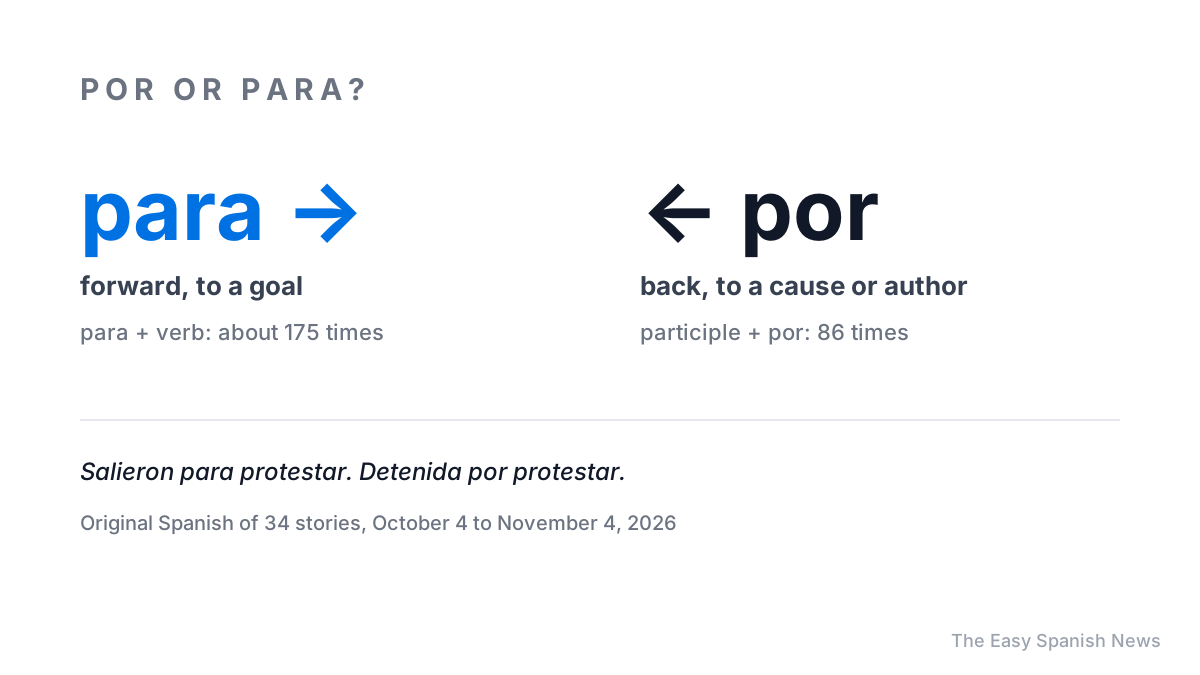
The biggest pattern in the whole count was para + infinitive, about 175 times in 33 of the 34 stories:
- Salieron a la calle para protestar. They took to the streets to protest.
- Trabajan para proteger el río. They work to protect the river.
Whenever English says "to" or "in order to" before a verb, Spanish wants para. That one rule covers a huge share of the word. Para que does the same job before a whole clause (16 times in 12 stories), and it brings the subjunctive with it: para que el Gobierno escuche.
The rest of para points forward too. It says who something is for or where it's headed: una ley para los trabajadores, un problema para el país.
What por does: it points back
If para looks ahead to a goal, por looks back at what's behind something: the cause, the person responsible, the route.
By whom
This was the most common job I could count: a participle followed by por, 86 times in 27 stories. Afectados por la guerra (affected by the war). Dirigido por una organización (run by an organisation). If you can say "by" in English, it's almost always por.
Because of what
Detenida por protestar (arrested for protesting). Cerrado por la inundación (closed because of the flood). English often says "for" here, which is exactly why people choose para by mistake. Ask yourself: is this the goal, or the reason? Nobody protests with the goal of being arrested.
Through where
Pasaron por el pueblo (they passed through the town). Por todo el país (all over the country).
The fixed phrases
A lot of por simply comes in set phrases, and these are worth learning whole. Here's how often they turned up, and one result that surprised me:
| Phrase | Meaning | Times | Stories |
|---|---|---|---|
| por qué | why | 10 | 5 |
| por lo que | so, which is why | 9 | 7 |
| por primera vez | for the first time | 8 | 7 |
| por ejemplo | for example | 8 | 6 |
| por su parte | for their part | 6 | 5 |
| por lo tanto | therefore | 4 | 3 |
| por eso | that's why | 2 | 1 |
Textbooks teach por eso early, and it's useful when you speak. But in written news it barely appeared. Por lo que, which most learners meet much later, was more than four times as common. That's a good reminder that spoken and written Spanish lean on different words.
One question that settles most cases
When you're stuck, ask: is this looking forward or back?
- Forward, to a goal or someone who receives it: para.
- Back, to a cause, an author or a path: por.
It won't explain every set phrase, but it handles the sentences you'll actually meet. Open today's story, find five of each, and ask the question every time. By the fifth, you'll be answering before you finish reading the sentence.