Preterite or imperfect? What 34 Spanish news stories show
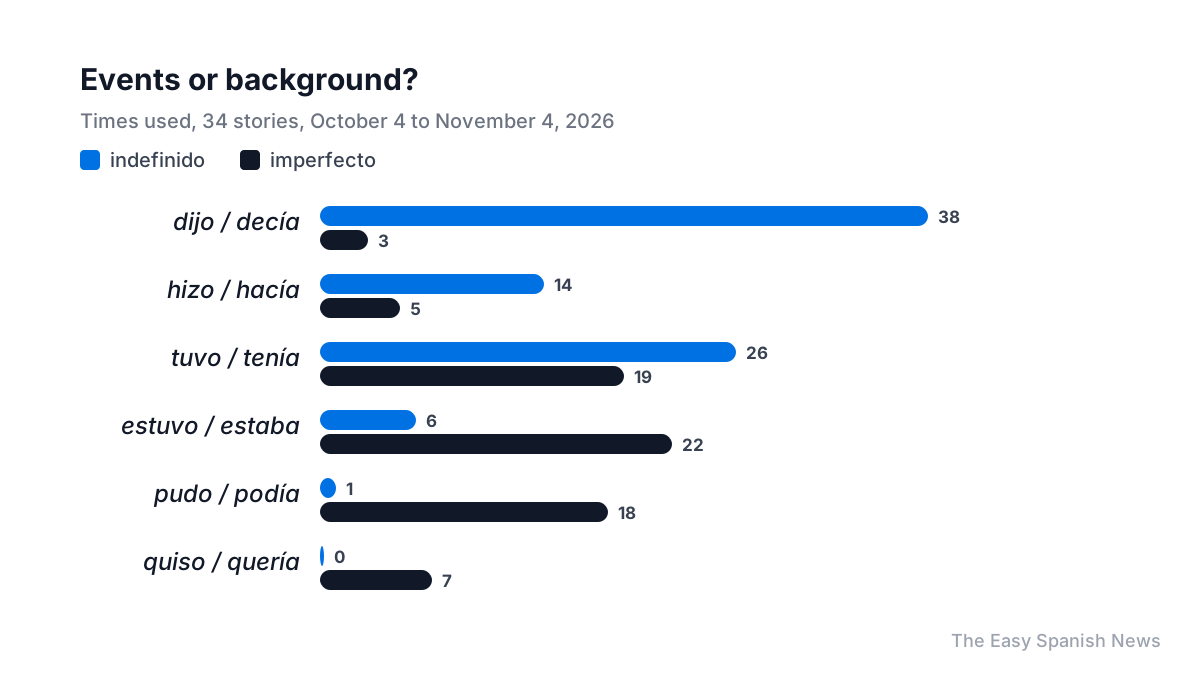
If ser and estar is the first big wall in Spanish, the indefinido and the imperfecto are the second. Dijo or decía? Fue or era? News is a good place to learn the difference, because a news story is mostly the past, told carefully.
I looked at the original Spanish of our 34 stories from October 4 to November 4, 2026, and counted the same seven common verbs in both tenses. The pattern is much clearer than I expected.
Some verbs lean hard one way
| Verb | Indefinido | Times | Imperfecto | Times |
|---|---|---|---|---|
| decir | dijo, dijeron | 38 | decía, decían | 3 |
| hacer | hizo, hicieron | 14 | hacía, hacían | 5 |
| tener | tuvo, tuvieron | 26 | tenía, tenían | 19 |
| estar | estuvo, estuvieron | 6 | estaba, estaban | 22 |
| poder | pudo, pudieron | 1 | podía, podían | 18 |
| querer | quiso, quisieron | 0 | quería, querían | 7 |
(I've left ser out of the table. It came to 87 against 65, but fue is also the past of ir, so that count can't be trusted.)
Look at the two ends. Dijo beat decía 38 to 3. Podía beat pudo 18 to 1. That isn't random. It's the whole rule, showing up in the numbers.
The rule: events and background
A story has two layers. The events move it forward: someone said something, a law passed, a river flooded. The background describes how things were while that happened.
- Indefinido for events. Saying something is a single act with an end, so it's dijo. The most common regular verbs in this tense were all of this kind: señaló (17 times), llegó (15), publicó (12), ocurrió (12).
- Imperfecto for background. Being able to do something, wanting it or being somewhere isn't an event. It's a state. So it's podía, quería, estaba.
Here are both in one sentence, which is how you'll usually meet them:
Cuando llegó la policía, la gente estaba en la plaza.
The police arriving is the event. People being in the square is the background. Try swapping them and the sentence falls apart.
Why the rare ones are interesting
When the less likely tense does appear, it usually means something. No podía salir says someone wasn't able to leave, as a situation. No pudo salir says they tried, once, and failed. Spanish makes that distinction with one small change of form.
The same goes for quería (wanted) and quiso (tried to, set out to). That's why quiso never turned up in 34 stories, and quería did seven times. News usually describes what people wanted, not a single attempt.
Don't forget the third past
The biggest surprise wasn't in the table. Ha or han + participle, the pretérito perfecto, appeared 230 times in 32 of the 34 stories: ha cambiado, han denunciado. News cares about what has happened and still matters now, so this is often the first past tense you'll see in a story. Then the details follow in the indefinido.
And when a story needs to go further back, it uses había or habían + participle: 37 times in 18 stories. Ya había terminado means it had already finished before the moment being told.
How to practise this
Take today's story at B1 and mark each past verb as an event or as background. Don't translate anything, just sort them. Do that for a few days and you'll start to feel which one a sentence wants, which is a lot more useful than remembering the rule.
If you read at A2, you'll meet all three past tenses already. They start at that level, as the guide to the levels explains.