A1, A2 or B1: which level of Spanish news should you read?
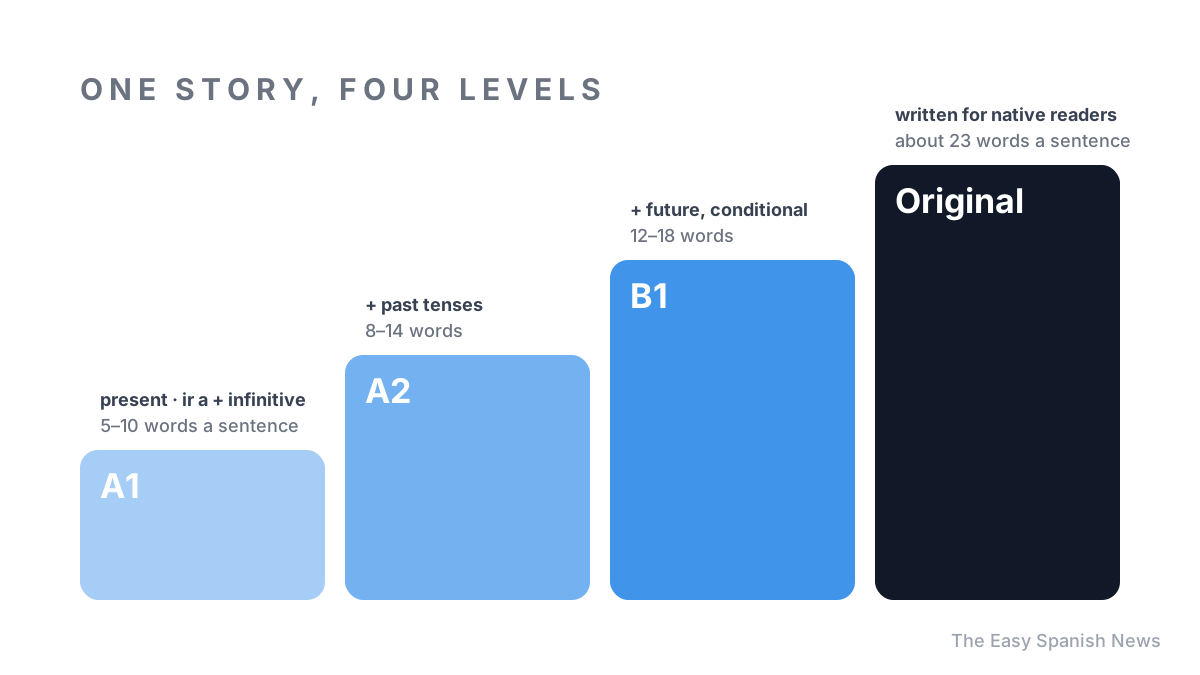
Every story on this site comes in four versions: A1, A2, B1 and the original. People ask me which one they should read, and the honest answer is "the one you can finish". That's not very helpful on its own, so here is what actually changes from level to level, and a quick way to find yours.
A1: the short version, in the present
A1 is a brief, not the whole article. It has six short paragraphs that tell you what happened, who was involved, where and when, the key number, why it matters and what comes next. In our first 15 stories, the A1 versions had a median of 253 words.
- Tenses: the present only. The past is told in the present with a time marker (En 2019, el Gobierno aprueba una ley), and the future is ir a + infinitive.
- Sentences: aimed at 5 to 10 words, one idea each.
- Words: the most common in Spanish. A rare word is swapped out or explained in a few words.
Read A1 if you know a few hundred words and the present tense, and longer texts still feel like a wall.
A2: the brief, with the past tenses
A2 is still a brief, with eight paragraphs instead of six. The extra room goes to context and to what people said about the story.
- Tenses: adds the past: ha anunciado, anunció, anunciaba. Still no subjunctive or conditional.
- Sentences: aimed at 8 to 14 words, with everyday connectors like pero, porque, por eso, cuando.
Read A2 if you've studied the past tenses and can follow a simple story, but a full news article still loses you halfway.
B1: the whole story, in shorter sentences
This is the big step.
B1 is no longer a summary. It follows the original paragraph by paragraph and keeps everything the original says. What changes is how it's said. Long sentences are cut into two or three, and side remarks between commas become sentences of their own. That's why a B1 version is often a little longer than the original.
- Tenses: adds the pluperfect, the future and the conditional, and the present subjunctive after a few fixed phrases: es necesario que, para que, aunque, cuando (about the future) and querer que.
- Sentences: aimed at 12 to 18 words and never more than 22. In our first 15 stories, B1 averaged 12 words a sentence.
Read B1 if A2 feels comfortable and you want the full story, details and all.
The original: real Spanish news
This is the text as published, written for native readers. In our first 15 stories it averaged 23 words a sentence, and one sentence in three ran past 25 words. We label it B2–C1. The vocabulary is part of the difficulty, but most of it comes from long sentences, with a clause tucked inside a clause and the main verb waiting at the end.
You don't need to read the original every day to make progress. Use it as a goal: once a week, open a story you've already read at B1 and try the original.
A two-minute test
Open today's story and read the first paragraph at A2. Then ask yourself:
- Did you need a translation for more than one word per sentence? Go to A1.
- Did you understand it with two or three lookups? A2 is your level.
- Did you understand it all without stopping? Try B1, and run the same test there.
Pick the level where you can finish.
You'll read more, and over a few months of reading a story a day, reading more is what actually moves you up a level, far more than any grammar exercise will. You can also switch level in the middle of a story whenever a paragraph gets hard.
The level pages have every story sorted for you: A1, A2 and B1. If you're starting out, the 20-minute reading routine shows how to work through a story once you've picked one.