10 Spanish false friends that actually come up in the news
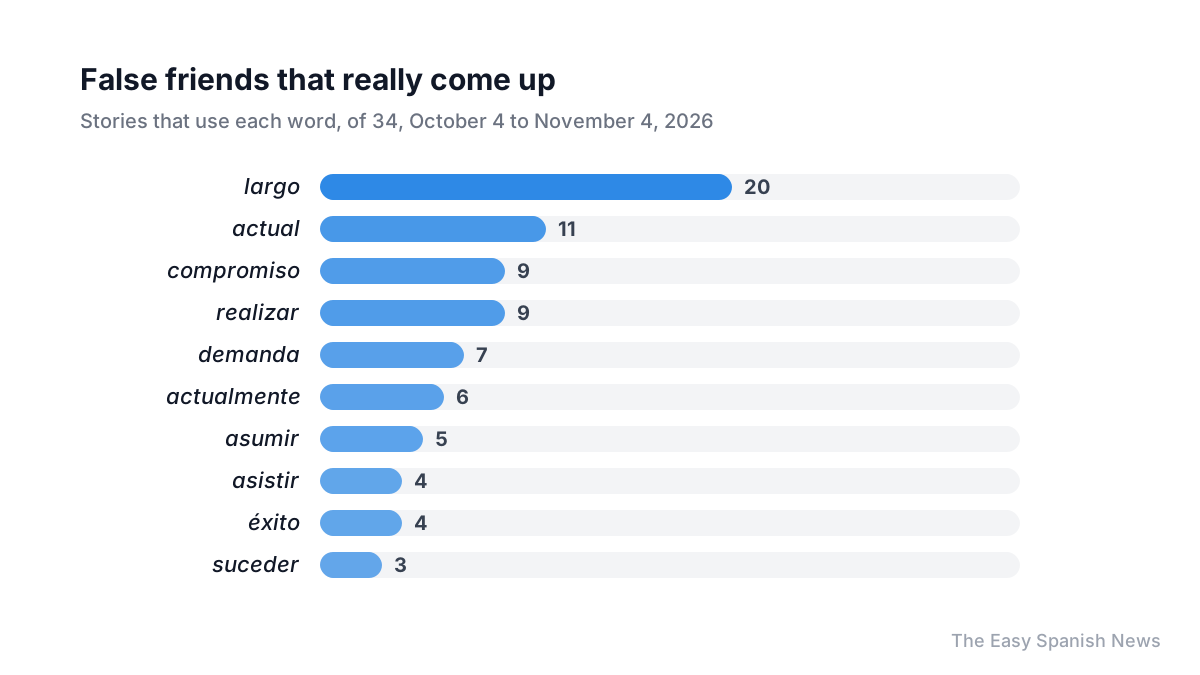
False friends are usually taught as a party trick. Everyone learns that embarazada doesn't mean embarrassed. It's a good story, but it never came up once in the 34 news stories I checked.
The false friends that actually slow you down are quieter. They look so familiar that you don't look them up, and the sentence goes slightly wrong without you noticing. So I searched the original Spanish of our stories from October 4 to November 4, 2026 for the usual suspects and kept the ones that really appear. The number is how many of the 34 stories used each word.
The ten that actually come up
| Spanish | Looks like | Really means | Stories |
|---|---|---|---|
| largo | large | long | 20 |
| actual | actual | current | 11 |
| compromiso | compromise | commitment | 9 |
| realizar | realize | to carry out | 9 |
| demanda | demand | demand, or a lawsuit | 7 |
| actualmente | actually | currently | 6 |
| asumir | assume | to take on | 5 |
| asistir | assist | to attend | 4 |
| éxito | exit | success | 4 |
| suceder | succeed | to happen | 3 |
The ones that change the meaning of a sentence
actual and actualmente
These two do the most damage, because the wrong reading still makes sense. El actual presidente isn't the "real" president. It's the current one. Actualmente vive en el extranjero doesn't mean someone actually lives abroad. It means they live abroad now. Together they appeared 23 times. If you want "actually" in Spanish, it's en realidad.
compromiso
La empresa reiteró su compromiso means the company repeated its commitment, which is close to the opposite of giving ground. A compromise in the English sense is un acuerdo or una concesión. This one can flip the point of a whole paragraph.
realizar
Realizaron un estudio means they carried out a study. Nobody realised anything. To realise something, in the sense of noticing, is darse cuenta de: me di cuenta del error.
asumir
Asumir la responsabilidad is to take responsibility, and asumir el cargo is to take office. In the news, you take something on. Spanish does have the English sense as well, but "to suppose" is more often suponer.
suceder
¿Qué sucedió? means "what happened?", not "who succeeded?". It's a more formal pasar. For success, you want tener éxito, and that one's the next trap: éxito has nothing to do with the way out. The exit is la salida.
The half-false ones
A couple of these are harder, because sometimes they do mean what they look like.
Demanda in the 34 stories meant all sorts of things: market demand for a kind of music, public demands for accountability, and at least once a civil lawsuit. Una demanda civil is a lawsuit. If the sentence has a court or a company in it, check.
Largo appeared in 20 stories, and 10 of those used the phrase a lo largo de (throughout, along). Learn that phrase and you've dealt with much of it. Also useful: largo plazo (long term), in 5 stories.
The dramatic ones barely appear
Embarazada, librería and fábrica, all classics of the false-friend list, came up zero times. Sensible (sensitive) came up once. Don't spend your time there. Spend it on actual.
How to catch them
The danger is that you won't tap a word you think you know. So if a sentence seems slightly off, tap the familiar word anyway, even when you're sure of it. On this site that takes a second. Try it on today's story: look for actual or realizar and see whether you'd have read it right.