Ser or estar? What 26 Spanish news stories show
Every Spanish learner gets the same rule for ser and estar: permanent versus temporary. Then you meet está muerto (he's dead) and the rule falls apart.
So instead of the textbook, I looked at how our news actually uses the two verbs. The corpus is the original Spanish of our 26 stories from October 4–27, 2026. To keep the count clean I compared present-tense forms only: fue is also the past of ir, and estado is usually the noun "state", so both would have skewed it.
The headline number: ser wins about three to one
Es and son appeared 268 times. Está and están appeared 93. If you're unsure in a news sentence, ser is the better bet. But the interesting part is what each one is doing.
What ser does in the news
Says what something is
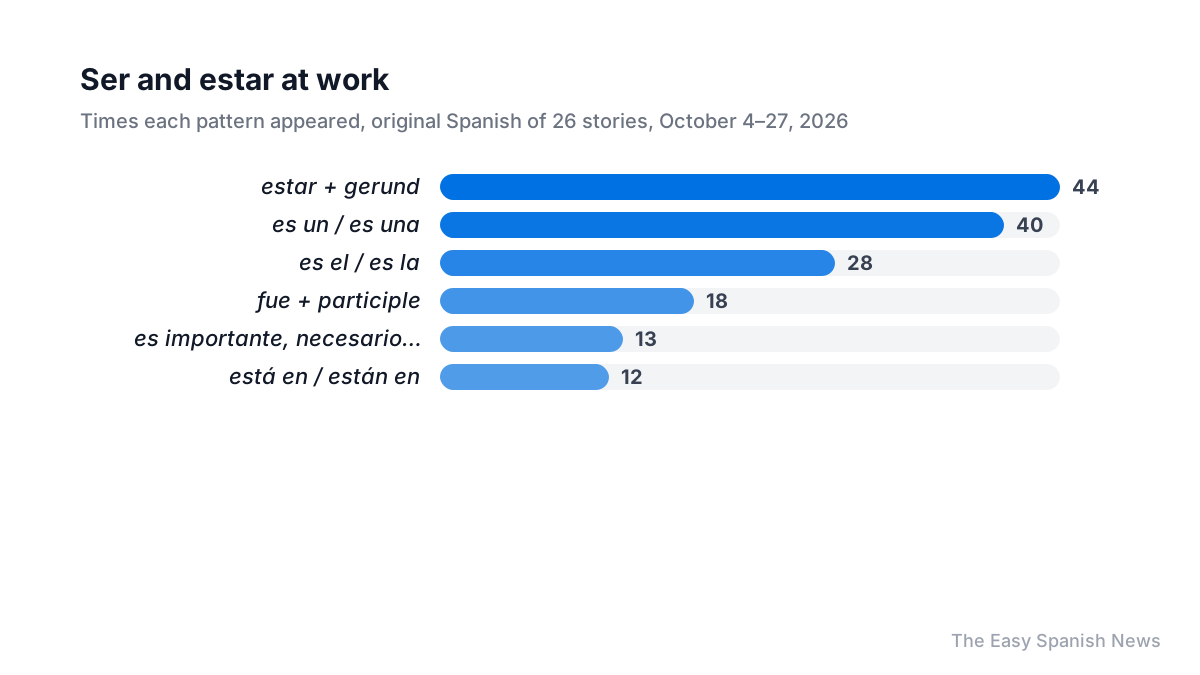
Es un / es una came up 40 times, and es el / es la 28 times. This is the most common job by far: es una organización, es el país más afectado. Ser puts something in a category. That's what news does all day.
Judges
Es importante, es necesario, es posible, es difícil: 13 times across 7 stories. These usually open someone's argument (es necesario que el Gobierno actúe), so they're worth noticing. An opinion is about to follow.
Builds the passive
Fue or fueron + participle came up 18 times in 9 stories: el puente fue construido en 2019 (the bridge was built in 2019). It's the textbook passive. In the news it usually marks something finished, with a date not far away.
What estar does in the news
Something in progress
This was the surprise. The most common job of estar wasn't location or mood. It was estar + gerund, 44 times in 16 of the 26 stories: están buscando (they're looking for), está creciendo (it's growing). News loves things that are happening right now, and this is how Spanish says it.
Where something is
Está en, están en: 12 times in 5 stories. Location always takes estar, even for things that never move: la ciudad está en el norte. (Events are the exception. A meeting or a protest that takes place somewhere uses ser: la protesta fue en la plaza.)
The state something has ended up in
Está cerrado, están obligados, está prohibido. This is the result of something that happened: someone closed it, someone obliged them. That's why está muerto takes estar. Death isn't temporary, but it's the state someone ended up in.
A rule that works better
Forget permanent versus temporary. For news, this works better:
- ser says what something is: a category, a judgement, or a passive event.
- estar says how or where something is: in progress, in a place, or in the state something left it in.
Compare el museo es nuevo (it's a new museum, that's what it is) with el museo está cerrado (it's closed, that's the state it's in). Same museum, two different questions.
Try it
Open today's story at B1 or the original and find three examples of each verb. For every one, ask "what is it?" or "how or where is it?" You'll be surprised how quickly the choice starts to feel obvious. And if a word in the sentence stops you, the 15 verbs the news uses most are a good next list.