The 15 verbs that carry Spanish news
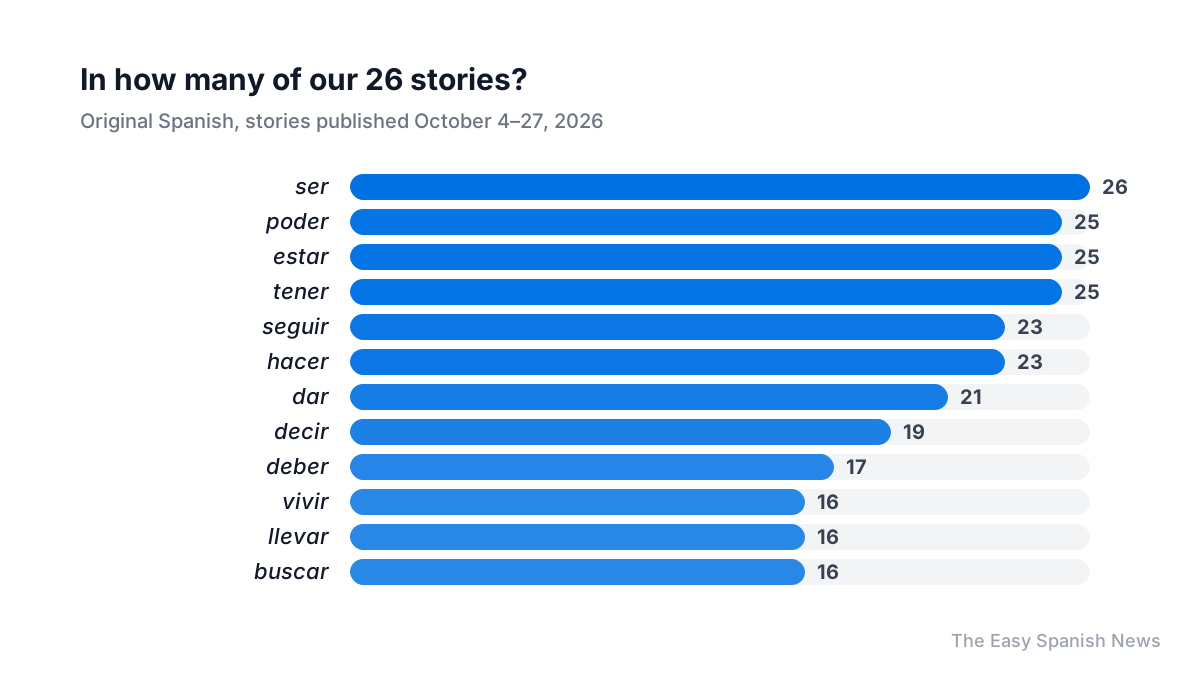
After counting the nouns and phrases in our stories, the obvious next question was the verbs. Nouns tell you what a story is about. Verbs tell you what's happening, and in Spanish they change shape constantly, so knowing which ones to learn first saves a lot of time.
Same method as before. I took the original Spanish of our 26 stories published October 4–27, 2026, counted every form of a verb together (puede, podía and podrían all count as poder), and counted each verb once per story. I left out ver, because its short forms (ve, ven) are shared with other verbs and would have inflated it.
The 15 that came up most
| Verb | Meaning | Stories (of 26) |
|---|---|---|
| ser | to be | 26 |
| poder | can, to be able to | 25 |
| estar | to be | 25 |
| tener | to have | 25 |
| seguir | to continue, to still be | 23 |
| hacer | to do, to make | 23 |
| dar | to give | 21 |
| decir | to say | 19 |
| deber | must, should | 17 |
| vivir | to live | 16 |
| llevar | to carry, to take | 16 |
| buscar | to look for, to try to | 16 |
| llegar | to arrive, to reach | 15 |
| quedar | to remain, to be left | 15 |
| crear | to create | 15 |
The top four were in nearly every story. Ser was in all 26. If you only have time for one thing this week, make it these four in the present, the pretérito indefinido and the imperfecto. You'll meet them in every article you open.
The ones worth a closer look
Some of these mean exactly what the dictionary says. Others do a different job in the news, and that's where learners get stuck.
poder: the news is full of "could"
It was in 25 of 26 stories, more than tener. News writers hedge a lot, and poder is how they do it: la ley podría cambiar (the law could change), la cifra puede ser mayor (the figure may be higher). When you see podría, read it as "might". The story is telling you this hasn't happened yet.
llevar: not just "to carry"
Two uses come up over and over. Llevar a cabo means to carry out: llevaron a cabo una campaña. And llevar + time + gerund means "have been doing something for": llevan tres años esperando (they've been waiting for three years). The second one has no word-for-word English match, so it's worth learning as a pattern.
quedar: what's left
Queda mucho por hacer (there's a lot left to do). Se quedaron sin trabajo (they were left without work). In the news, quedar is almost always about what remains after something happened.
dar and hacer: the busy ones
Both appear in fixed phrases more than on their own. With dar: dar a conocer (to make known), dar lugar a (to lead to). With hacer: hace dos años (two years ago) and hacer frente a (to face). If a sentence with one of these looks odd, look up the whole phrase, not the verb.
buscar: trying, not just looking
El proyecto busca reducir la pobreza doesn't mean the project is looking for something. It means it aims to reduce poverty. Buscar + infinitive is "to try to" or "to aim to", and the news uses it constantly.
deber: should, and must
El Gobierno debe actuar (the government must act) is an opinion, and it's usually someone's demand. When you see debe or debería (should), ask yourself who is saying it. That's often the point of the paragraph.
How I'd use this list
- Learn the top four in three tenses before anything else. That covers a surprising share of every sentence.
- For the rest, learn one news use each, with an example sentence: llevan tres años esperando, queda mucho por hacer, busca reducir.
- Hunt for them. Open today's story at your level and count how many of the 15 you can spot. Save the sentences where they confused you.
If you missed it, the 25 words and phrases list covers the nouns and connectors from the same stories. Between the two, you have most of what holds a Spanish news article together.