What does "se" mean in Spanish? 5 uses from real news
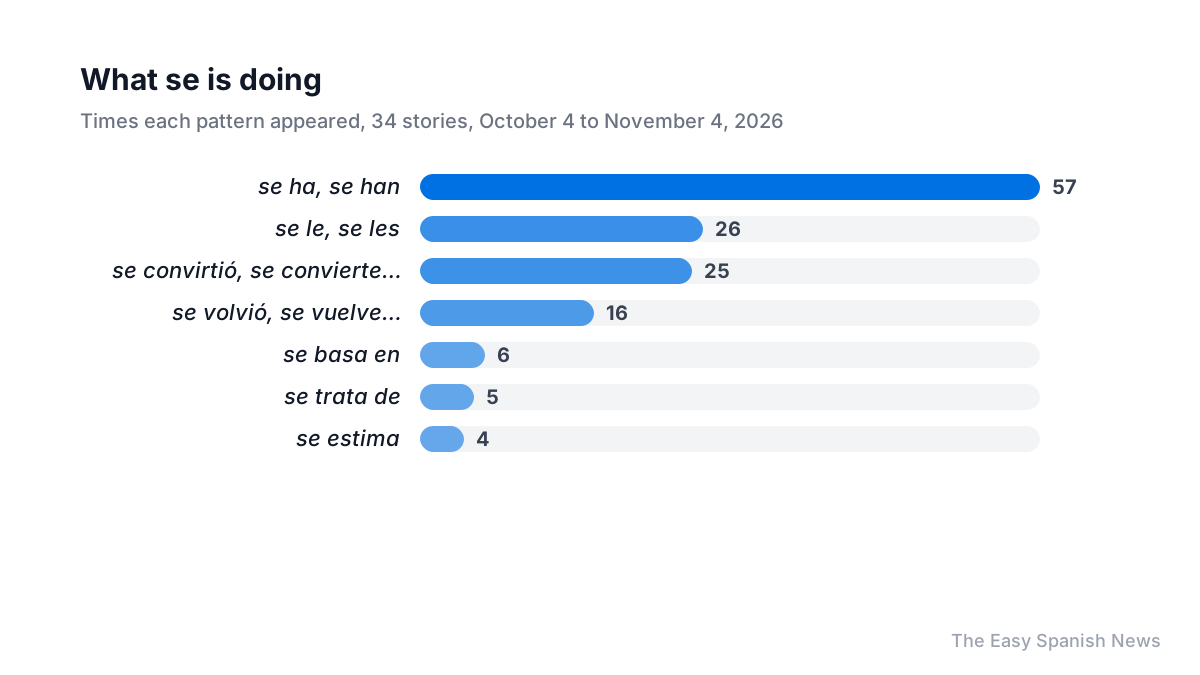
Two letters, and more trouble than almost any word in Spanish. Se appeared 572 times in our 34 stories from October 4 to November 4, 2026. That's about once every 93 words, in every story. So if a sentence with se confuses you, it'll happen again in the next paragraph.
Textbooks usually say it means "himself" or "herself". In the news it almost never does. Here's what it was actually doing.
1. Nobody in particular: "it is said"
This is the one to learn first. News often reports something without saying who did it, and Spanish uses se for that:
- Se estima que hubo 500 protestas. It's estimated that there were 500 protests. (4 times in 4 stories)
- Se considera un delito. It's considered a crime. (4 times)
- Se sabe que la cifra es mayor. It's known that the figure is higher. (4 times)
- Se puede ver desde la plaza. It can be seen from the square. (5 times)
When you see this, translate it with "it is" or "people", and don't look for a person. There isn't one. Often that's the point: the writer doesn't know who, or isn't saying.
2. Things happen to things: the passive
Se celebró una reunión (a meeting was held). Se publicó el informe (the report was published). A report can't publish itself, so don't read it as "itself". Spanish prefers this to fue publicado in most ordinary writing. If the verb is plural, the thing is too: se publicaron los datos.
3. Becoming: one English word, two Spanish verbs
Two verbs mean "to become", and both need se:
- Se convirtió en un símbolo. It became a symbol. Forms of convertirse came up 25 times in 15 stories.
- Se volvió más difícil. It became harder. Forms of volverse came up 16 times in 12 stories.
Use convertirse en before a noun, when something turns into something else. Use volverse before an adjective, for a change of state. There's no single word for "become" in Spanish, so it's worth learning these two as a pair.
4. Se le, se les: done to someone
Se le and se les came up 26 times in 13 stories, and they're the ones that look strangest. The le or les is the person affected:
- Se les paga por hacerlo. They're paid to do it.
- Se le negó la entrada. They were denied entry.
Read it in the English passive: "they are paid". Again, nobody in particular is doing it.
5. Verbs that simply come with se
Some verbs need se, and the meaning isn't what you'd guess from the parts:
- Se trata de un problema antiguo. It's an old problem. (5 times in 4 stories.) It doesn't mean "it treats". It's a formal way of saying "this is" or "it's about".
- El informe se basa en entrevistas. The report is based on interviews. (6 times in 4 stories)
- Los vecinos se reúnen cada semana. The neighbours meet every week.
One more trap: se ha, se han
Se ha and se han came up 57 times in 26 stories. These are all the patterns above in the past: se ha convertido, se han publicado. The se always goes before ha, never between it and the participle. If you've read that far, you know what the sentence means.
A simple way to read it
When you hit se, ask two questions:
- Who's doing this? If the answer is nobody or everybody, it's patterns 1, 2 or 4. Use "it is" or a passive.
- Is it a verb I should learn with se? If so, tap it and save the whole phrase, se trata de rather than tratar.
Hunt for them in today's story. With one every 93 words, you won't have to look far.