How to remember the Spanish words you look up
You look up el aumento on Monday. On Thursday you meet it again, in a different story, in a sentence you'd otherwise understand, and it means nothing at all.
Sound familiar?
That isn't a memory problem. Looking a word up and remembering it are two different jobs, and most of us only do the first. Here's how I handle the second, and how the flashcards on this site are set up to do it with you.
Why looked-up words vanish
When you tap a word, you understand it for the length of one sentence. Your brain has no reason to keep it, because nothing tells it the word matters. What tells it that is meeting the word again, at the moment you're about to forget it. Do that a few times, with the gaps getting longer each time, and the word stays.
That's all spaced repetition is.
The hard part is the timing, and that's the part software is good at.
Save the sentence, not just the word
A card that says seguir = "to follow" will teach you a meaning you'll rarely need in the news. A card with the sentence it came from, la situación sigue siendo difícil, teaches you the meaning you will need: "is still". The sentence also gives you the gender, the preposition and the kind of text the word lives in.
So when you save a word here, it keeps the article it came from. When you review it, you're reminded where you met it.
Fewer words, reviewed properly
The temptation is to save everything you didn't know. I've done it. You end up with sixty cards on day three and you quit on day five.
Save five a story. Pick the ones you met twice, or the ones that obviously come back in every story: sin embargo, las autoridades, el gobierno. Skip the name of a rare bird or a one-off place. It isn't worth a card.
What the review buttons do
After each card you choose how well you knew it. Here's what each button does to the next review:
- Again: you'll see it again in about ten minutes, and the word is treated as harder from now on.
- Hard: the gap grows a little.
- Good: the gap grows by about two and a half times.
- Easy: it grows faster still.
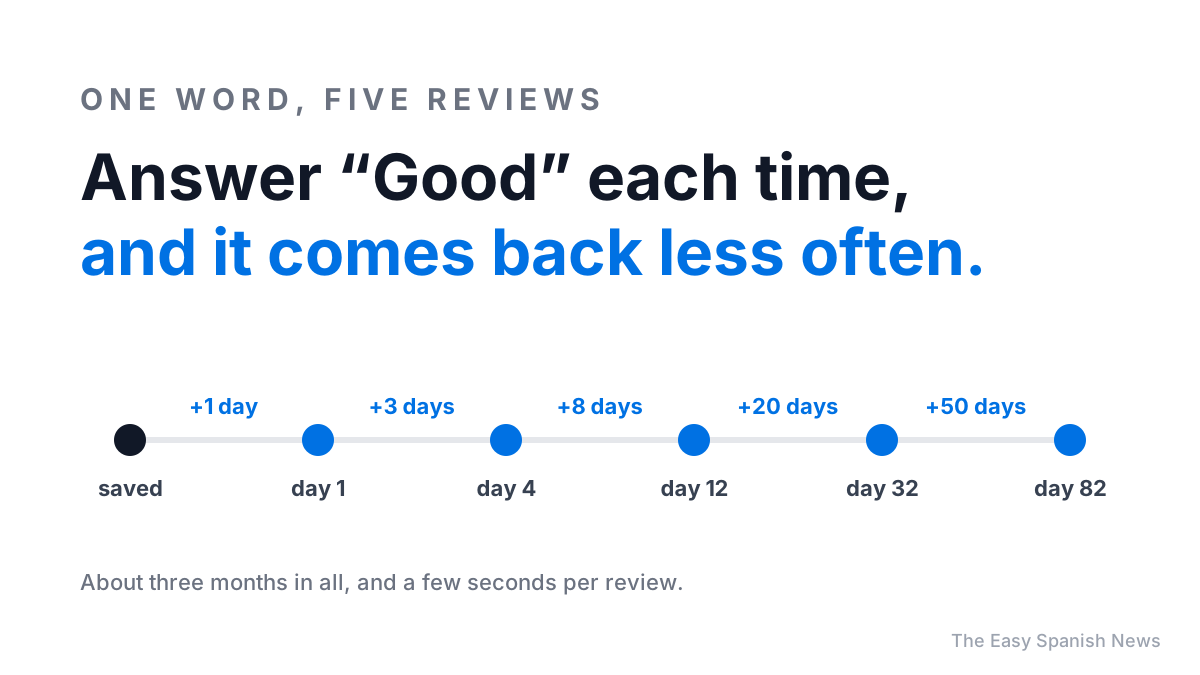
Answer Good every time and a new word comes back after 1 day, then 3, then 8, then 20, then 50. That's five reviews spread over roughly three months, a few seconds each. By the end you don't need the card any more, because you've met the word in its sentence six times.
Be honest with the buttons. Pressing Good on a word you half-guessed just means you'll forget it on a longer schedule.
Read, then review
The routine that works for me is reading first and reviewing second. Read today's story at your level, save your five words, then clear whatever cards are due. Most days that's under ten minutes of review. Words that show up in the story and in your cards on the same day stick fastest of all.
Not sure which words to start with? Next week I'll post the 25 words and phrases that came up most in our first 15 stories. They make a good first deck.
Getting started
Tap any word in an article and choose Save word. You'll need a free account, which holds up to 30 words. Plus removes the limit. Your cards are waiting under Practice the next day. That's it. The scheduling is the software's job. Yours is to show up.